
24×7 – 365 Days | orders@courierstoindia.com
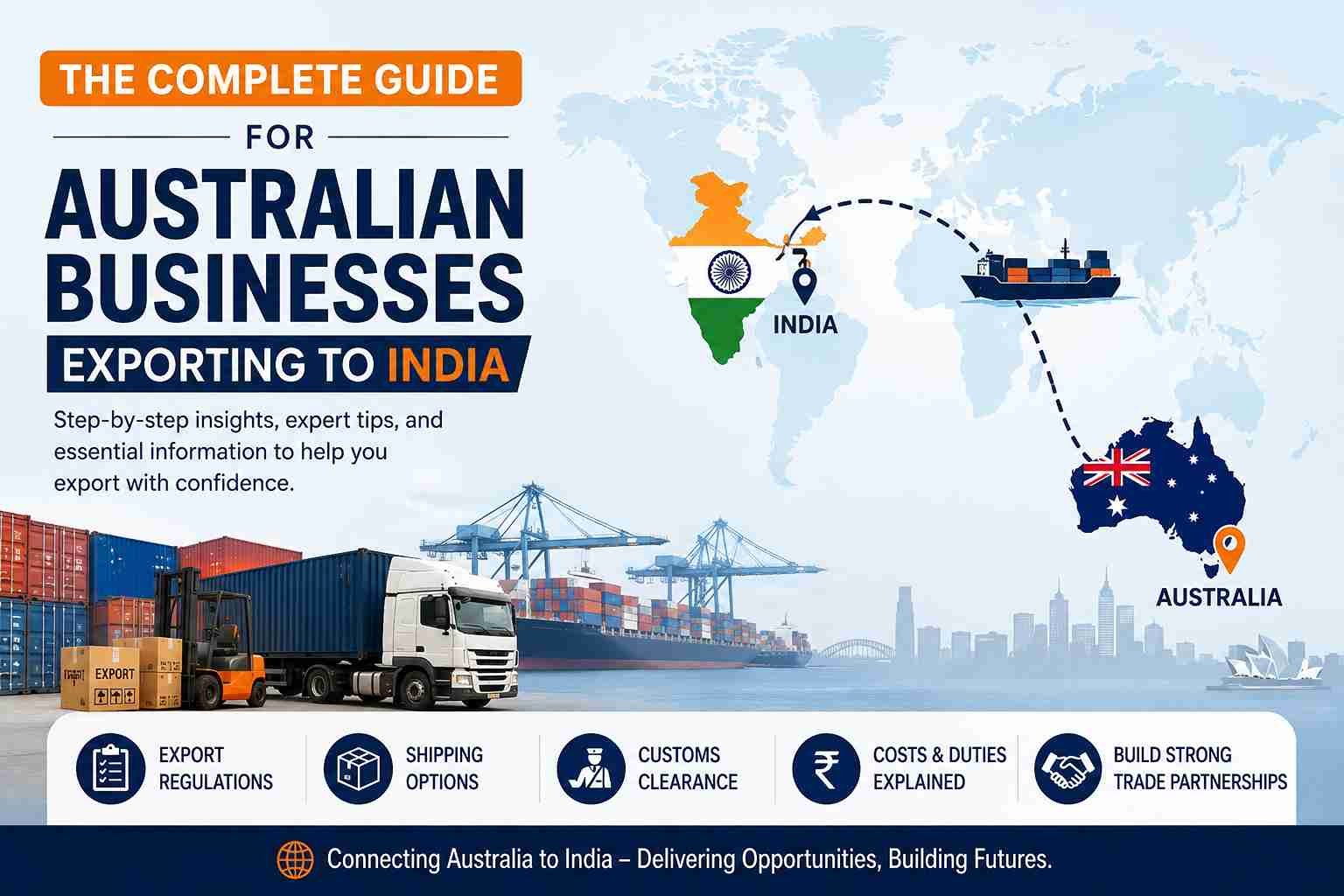
Unlock New Export Opportunities with the Australia-India Economic Cooperation and Trade Agreement (ECTA)
India is one of the world’s most promising markets for Australian exporters. With a rapidly expanding consumer base, increasing demand for premium international products, and stronger trade relations between the two countries, Australian businesses have more opportunities than ever to grow their presence in India.
The Australia-India Economic Cooperation and Trade Agreement (ECTA) has further strengthened this relationship by reducing trade barriers and improving market access for eligible Australian exports. For small and medium-sized businesses (SMEs), this agreement makes it easier to compete in one of the fastest-growing consumer markets in the world.
But taking advantage of these opportunities is more than just sending a parcel abroad. Businesses need to know about export documentation, customs requirements, product classification, packaging standards, and shipping processes to ensure that their goods reach customers without unnecessary delays.
Whether you are selling skincare products, health supplements, fashion, food products, electronics, or specialized equipment, the right shipping strategy can make a big difference to your customer experience and overall business success.
This comprehensive guide explains everything Australian businesses need to know about exporting to India under ECTA, including:
Understanding how the Australia-India ECTA works
Benefits available to Australian exporters
Required export documentation
Customs and KYC requirements
Packaging best practices
Shipping tips to minimise delays
Common export mistakes to avoid
How Couriers to India helps simplify international shipping
Let’s begin by understanding what the Australia-India ECTA means for Australian businesses.
Before shipping from Australia to India, remember these important points:
✔ Check whether your products qualify under the Australia–India ECTA.
✔ Confirm the correct HS Code for your goods.
✔ Obtain a Certificate of Origin where required.
✔ Prepare accurate invoices and supporting documentation.
✔ Ensure recipient information is complete and accurate.
✔ Package products securely using suitable materials.
✔ Understand customs and KYC requirements before dispatch.
✔ Plan shipments ahead of busy periods to help minimize delays.
Following these best practices can contribute to a smoother international shipping experience for both businesses and customers.
The Australia-India Economic Cooperation and Trade Agreement (ECTA) is a bilateral pact introduced to reduce trade barriers and enhance market access for businesses in both countries.
Entering into force on 29 December 2022, the agreement implements staged tariff reductions. Eligible Australian exporters can benefit from lower or eliminated import duties into India, provided they meet specified rules of origin and documentation requirements.
For Australian businesses, ECTA is designed to:
While the agreement provides a lot of opportunities, businesses must ensure they satisfy the applicable eligibility requirements, including providing the appropriate export documentation where necessary.
Small and medium-sized businesses expanding internationally often face complex challenges, including import duties, customs procedures, documentation, and shipping costs, which can impact profitability.
ECTA helps mitigate these hurdles by improving trading conditions between Australia and India.
Some of the key advantages include:
Reduced trade barriers allow Australian businesses to introduce their products to a larger customer base across India.
Where eligible products qualify for reduced import duties under ECTA, Australian businesses may be able to offer more competitive pricing compared with markets where higher tariffs apply.
Businesses across a wide range of industries—including agriculture, food, health, education, manufacturing, fashion, and consumer goods—may benefit from increased export opportunities as trade between Australia and India continues to grow.
Simplified trade arrangements can encourage long-term partnerships between Australian exporters and Indian distributors, retailers, wholesalers, and online marketplaces.
Driven by growing urbanization, rising incomes, and digital adoption, India has become one of the world’s largest consumer markets, creating strong demand for domestic and imported goods.
These key factors make India a highly attractive destination for Australian exporters.
A growing middle-income population is creating demand for quality products across categories such as the following:
Consumers are increasingly researching products online before making purchasing decisions, creating opportunities for Australian brands that emphasize quality, authenticity, and innovation.
India’s e-commerce sector continues to expand as more consumers are connecting to the internet. This growth provides Australian businesses with additional channels to reach customers directly or through online marketplaces.
Australian products are recognized internationally for high manufacturing standards, food safety regulations, quality assurance, and innovation. This reputation creates opportunities for businesses offering premium goods across multiple industries.
ECTA opportunities span numerous industries. While demand varies with market conditions and consumer preferences, Australian exporters commonly explore sectors such as:
Australian-made vitamins, nutritional supplements, wellness products, and personal healthcare items continue to attract interest among consumers seeking premium international brands.
Natural skincare, organic beauty products, sunscreen, cosmetics, and personal care products from Australia are increasingly recognized for their quality and ingredient standards.
Australian exporters supply a variety of food products, including:
Businesses exporting food products should always ensure they meet India’s import regulations and any applicable food safety requirements.
Australian fashion brands offering premium clothing, sustainable materials, wool products, and lifestyle apparel may find opportunities among India’s growing urban consumer base.
Books, educational materials, laboratory equipment, training resources, and specialized learning products also form part of Australia’s export relationship with India.
Before sending your first commercial shipment to India, it is important to complete several essential steps.
✔ Confirm that your product can be imported into India.
✔ Check whether your goods qualify for benefits under ECTA.
✔ Verify the correct Harmonized System (HS) Code for your products.
✔ Prepare accurate commercial invoices and export documentation.
✔ Ensure the recipient’s name matches their official identification documents where required.
✔ Package products securely for international transport.
✔ Understand customs clearance requirements before dispatch.
Completing these checks before shipping can help reduce delays, minimize customs queries, and create a smoother delivery experience for your customers.
While ECTA has simplified trade between Australia and India, businesses only benefit when they understand how to apply the agreement correctly.
In the next section, we’ll explain the following:
The Australia-India Economic Cooperation and Trade Agreement (ECTA) provides new opportunities for Australian exporters, but preferential tariff treatment is not automatic. To qualify, businesses must ensure products meet eligibility criteria and prepare required export documentation accurately.
Properly preparing shipments supports smoother customs clearance and reduces the risk of delays from incomplete or incorrect paperwork.
Generally, the process involves:
Confirming your products are eligible under ECTA.
Determining the correct Harmonized System (HS) Code.
Ensuring your goods satisfy the applicable Rules of Origin.
Obtaining a valid Certificate of Origin (where required).
Preparing accurate commercial shipping documents.
Working with an experienced international courier that understands shipping to India.
Rules of Origin (RoO) are crucial under ECTA, as they determine whether a product qualifies for preferential trade treatment.
Simply exporting an item from Australia does not automatically guarantee it is considered an Australian-origin product for ECTA purposes.
Depending on the type of goods being exported, eligibility may be based on factors such as:
Businesses should review the applicable Rules of Origin before claiming any tariff preferences.
If you’re unsure whether your products qualify, consider consulting the relevant Australian trade authorities or a customs professional before shipping.
A Certificate of Origin (CoO) officially verifies where exported goods were produced or manufactured. Under ECTA, eligible shipments entering India may require this document to secure preferential tariff benefits by proving compliance with the agreement’s origin requirements. Without it, those products may not receive any available tariff treatment.
A Certificate of Origin (CoO) officially verifies where exported goods were produced or manufactured. Under ECTA, eligible shipments entering India may require this document to secure preferential tariff benefits by proving compliance with the agreement’s origin requirements. Without it, those products may not receive any available tariff treatment.
Australian exporters can obtain Certificates of Origin through authorized issuing bodies, including organizations recognized under trade agreements.
To avoid customs queries or delays, businesses must ensure the certificate is completed accurately and matches all other export documents.
International shipping relies heavily on documentation.
Minor errors, like incorrect product descriptions or inconsistent invoice details, can cause customs to delay clearance and request more information.
Preparing accurate documents helps:
Many customs-related delays occur because documentation is incomplete rather than because of the products themselves.
Required documentation depends on shipment type, value, and goods.
Commercial shipments typically require the following:
The commercial invoice provides customs authorities with important information about the shipment.
It generally includes:
Product descriptions should be specific and accurate.
For example:
Instead of:
Beauty Product
Use:
Organic Vitamin C Facial Serum – 50ml
Specific descriptions help customs authorities classify products more efficiently.
A packing list provides a detailed summary of the shipment contents.
It usually includes:
Although similar to a commercial invoice, the packing list focuses on the physical contents rather than financial information.
Every shipment should display a clear and accurate shipping label containing:
Labels should be securely attached and remain clearly visible throughout transit.
Where exporters intend to claim preferential treatment under ECTA, an appropriate Certificate of Origin may be required.
Businesses should confirm the applicable requirements before shipping.
Certain products may require additional documentation depending on their category and India’s import regulations.
Examples include:
Requirements vary according to the product being shipped.
Often misunderstood, the Harmonized System (HS) Code is a globally recognized numerical classification system used by customs authorities.
It helps determine product categories, applicable import duties, regulatory requirements, statistical reporting, and trade agreement eligibility.
Using the correct code ensures more efficient customs processing.
Incorrect classification may result in:
If you’re uncertain about the appropriate HS Code for your products, it’s advisable to seek guidance before exporting.
Many international shipments entering India require recipients to complete Know Your Customer (KYC) verification for customs clearance.
This allows authorities to verify the recipient’s identity, and government-issued identification may be requested based on customs requirements.
Commonly accepted identification documents may include:
The exact documentation required can vary depending on the shipment and recipient.
Businesses can help reduce delays by ensuring that:
Preparing customers in advance often results in a smoother customs clearance process.
Many customs delays can be prevented by avoiding common documentation errors, including:
❌ Using vague product descriptions
❌ Incorrect invoice values
❌ Missing commercial invoices
❌ Incorrect HS Codes
❌ Incomplete recipient information
❌ Mismatched names between shipping documents and identification
❌ Missing supporting certificates where required
Reviewing your paperwork before dispatch can save valuable time once the shipment reaches customs.
Preparing export documentation can seem complex, particularly for businesses shipping internationally for the first time.
At Couriers to India, we help Australian businesses navigate the shipping process by providing guidance on shipment preparation, documentation requirements, and customs procedures.
Our goal is to make shipping from Australia to India as straightforward as possible, allowing businesses to focus on growing their exports while ensuring shipments are prepared correctly before dispatch.
Proper packaging plays a vital role in international shipping. A well-packed shipment is better protected during handling, transit, customs inspections, and final delivery.
Unlike domestic deliveries, international parcels often pass through multiple handling points before reaching the recipient. Using suitable packaging materials can help minimize the risk of damage and ensure your products arrive in good condition.
Whether you’re shipping commercial goods, business samples, or customer orders, investing a little extra time in packaging can prevent unnecessary delays and replacement costs.
Proper packaging plays a vital role in international shipping. A well-packed shipment is better protected during handling, transit, customs inspections, and final delivery.
Unlike domestic deliveries, international parcels often pass through multiple handling points before reaching the recipient. Using suitable packaging materials can help minimize the risk of damage and ensure your products arrive in good condition.
Whether you’re shipping commercial goods, business samples, or customer orders, investing a little extra time in packaging can prevent unnecessary delays and replacement costs.
Always use a sturdy corrugated cardboard box that is appropriate for the size and weight of your shipment.
The box should:
Using oversized boxes can increase shipping costs and allow products to move during transit.
Items should be secured to prevent movement while the parcel is in transit.
Depending on the products you’re shipping, protective materials may include the following:
Fragile items should be individually wrapped before being placed inside the shipping carton.
If multiple items are packed together, use dividers or cushioning between each product to reduce the risk of impact damage.
A quality packaging tape helps keep your shipment secure throughout its journey.
For best results:
A properly sealed package is less likely to open during transport.
Some regions experience humid weather conditions at different times of the year. Certain products—such as electronics, documents, textiles, or food items—may require additional protection against moisture.
Depending on the product, businesses may consider the following:
The packaging method should always suit the product being shipped.
If your shipment contains fragile products such as glassware, ceramics, or delicate equipment, apply appropriate handling labels where required.
While parcels are handled carefully throughout the shipping process, suitable packaging remains the most effective way to protect fragile items.
Different products require different levels of protection during international transit.
Health and Beauty Products
Ensure bottle caps are tightly sealed.
Use leak-resistant packaging for liquids.
Wrap glass containers individually.
Place absorbent material around liquid containers where appropriate.
Where permitted under import regulations:
Always verify that your products comply with India’s import requirements before dispatch.
Electronic products should be packed using:
Clothing should be packed in moisture-resistant bags before being placed inside shipping cartons.
Vacuum packaging may help reduce parcel size for certain textile products, where appropriate.
One of the most common questions businesses ask is:
“How long does shipping from Australia to India take?”
Delivery times vary depending on several factors, including:
Rather than focusing only on speed, businesses should also consider reliability, shipment tracking, and customs support when choosing an international courier.
Although many shipments move smoothly through the shipping process, delays can occasionally occur due to circumstances beyond the courier’s control.
Some common reasons include:
Customs authorities may inspect shipments to verify documentation or examine goods.
This is a routine part of international trade and does not necessarily indicate a problem.
Incomplete paperwork may require customs authorities to request additional information before releasing a shipment.
Checking documentation before dispatch helps minimize this risk.
Vague product descriptions or inaccurate invoice details may cause additional customs queries.
Providing detailed, accurate information upfront supports faster processing.
Demand for international shipping often increases around the following times:
Planning shipments in advance can help businesses avoid seasonal congestion.
Managing shipping expenses is important for businesses of all sizes.
Here are some practical ways to optimize shipping costs without compromising service quality.
Using packaging that closely matches your product dimensions can help reduce unnecessary shipping costs associated with oversized parcels.
Where practical, consolidating multiple products into a single shipment may be more cost-effective than sending several smaller parcels.
Businesses should evaluate shipment size, delivery requirements, and customer expectations when considering consolidation.
Accurate paperwork helps reduce the likelihood of customs delays that could lead to additional administrative costs or shipment interruptions.
Shipping early provides greater flexibility and may help avoid delays associated with periods of high demand.
As your product range evolves, reviewing packaging methods can help improve efficiency while maintaining product protection.
Small packaging improvements can contribute to long-term shipping savings.
Even experienced exporters occasionally encounter avoidable issues.
Here are some of the most common mistakes:
Descriptions such as the following:
Provide limited information for customs authorities.
Instead, describe products clearly and accurately.
Commercial invoices should accurately reflect the value of the goods being exported.
Incorrect valuation may result in customs queries or additional documentation requests.
Always confirm:
Accurate delivery information supports smoother customs clearance and final delivery.
Certain products may be subject to additional import regulations or restrictions.
Businesses should confirm applicable requirements before shipping.
Insufficient internal protection increases the likelihood of damage during international transit.
Quality packaging is an investment in customer satisfaction.
International shipping involves more than transporting parcels—it requires careful coordination between documentation, customs procedures, tracking, and final delivery.
At Couriers to India, we help businesses simplify this process by providing reliable shipping solutions from Australia to destinations across India.
Businesses choose us because we offer:
Whether you’re shipping a single parcel or managing regular commercial exports, our team works with you to help ensure your shipment is prepared for international delivery.
1. What is the Australia–India Economic Cooperation and Trade Agreement (ECTA)?
The Australia–India Economic Cooperation and Trade Agreement (ECTA) is a bilateral trade agreement that aims to strengthen trade and economic cooperation between Australia and India. It provides preferential market access for many eligible goods and services, subject to the agreement’s terms, including Rules of Origin and documentation requirements.
2. Do all Australian products qualify for reduced import duties under ECTA?
No. Eligibility depends on several factors, including the product’s HS Code, Rules of Origin, and compliance with the agreement’s requirements. Businesses should verify whether their products qualify before claiming preferential tariff treatment.
3. What is a Certificate of Origin, and why is it important?
A Certificate of Origin (CoO) confirms where exported goods were produced or manufactured. For eligible shipments, customs authorities may require this document to determine whether the goods qualify for preferential tariff treatment under ECTA.
4. What documents are generally required to ship commercial goods from Australia to India?
Documentation requirements vary depending on the shipment and product category. Commonly required documents include:
Commercial Invoice
Packing List
Shipping Label
Certificate of Origin (where applicable)
Any additional certificates or permits required for specific products
Preparing complete and accurate documentation can help minimise customs delays.
5. What is an HS Code?
An HS (Harmonised System) Code is an internationally recognised product classification code used by customs authorities worldwide.
It helps determine:
Product classification
Applicable duties and taxes
Import regulations
Trade agreement eligibility
Using the correct HS Code supports smoother customs processing.
6. Why might customs request KYC documents from the recipient?
Indian customs may require recipients to complete Know Your Customer (KYC) verification to confirm their identity before a shipment is released for delivery.
Depending on the shipment, recipients may be asked to provide government-issued identification in accordance with customs requirements.
7. Can customs inspections delay my shipment?
Yes. Customs authorities may inspect selected shipments as part of standard border procedures.
Providing accurate documentation, correct product descriptions, and complete recipient information can help reduce the likelihood of avoidable delays.
8. How can I reduce the chances of customs delays?
Some practical steps include:
Using accurate product descriptions
Declaring the correct shipment value
Preparing complete documentation
Verifying recipient details
Using the correct HS Code
Ensuring required certificates are included where applicable
9. Can I ship food, cosmetics, or health products to India?
Some food, cosmetic, and health-related products can be shipped to India, provided they comply with applicable import regulations.
Requirements may vary depending on the product category. Before shipping, it’s advisable to confirm whether any additional documentation, certifications, or approvals are required.
10. What factors influence international shipping costs?
Shipping charges typically depend on factors such as:
Parcel weight
Parcel dimensions
Pickup and delivery locations
Selected shipping service
Nature of the goods
Additional services requested
Choosing appropriately sized packaging and preparing shipments correctly can help optimise shipping costs.
11. Can businesses send regular commercial shipments to India?
Yes. Many Australian businesses regularly export commercial goods to customers, distributors, retailers, and business partners in India.
Working with an experienced international courier can help simplify documentation, shipment preparation, and delivery.
12. Why choose Couriers to India for shipping from Australia?
At Couriers to India, we understand that international shipping involves much more than transporting parcels.
Our team assists businesses and individuals with reliable shipping solutions, helping customers prepare shipments for international delivery while providing shipment tracking and customer support throughout the process.
Whether you’re sending occasional parcels or managing regular exports, we aim to make the shipping experience as smooth and straightforward as possible.
Exporting successfully involves more than preparing paperwork and booking a courier.
Businesses also need confidence that their logistics partner understands international shipping requirements, provides shipment visibility, and offers support throughout the delivery process.
An experienced international courier can help streamline shipping by assisting with documentation requirements, coordinating parcel movement, and keeping customers informed through shipment tracking.
For businesses expanding into India, having dependable logistics support allows more time to focus on sales, customer relationships, and business growth.
The Australia–India Economic Cooperation and Trade Agreement has created new opportunities for Australian businesses looking to expand into one of the world’s largest and fastest-growing consumer markets.
While the agreement can provide significant advantages for eligible exports, success depends on careful planning, accurate documentation, compliant packaging, and an understanding of customs procedures.
Whether you’re shipping retail products, commercial orders, samples, or business consignments, preparing each shipment correctly helps reduce delays and creates a better experience for your customers.
At Couriers to India, we’re committed to making international shipping from Australia to India simpler, more transparent, and more reliable. From pickup and shipment preparation to tracking and delivery, our team is here to support businesses and individuals at every stage of the shipping journey.
If you’re ready to expand your business into India or send your next shipment with confidence, Couriers to India can help you navigate the process with reliable international courier solutions tailored to your shipping needs.
India continues to present significant opportunities for Australian exporters across industries such as food, health, beauty, fashion, education, and consumer goods. By understanding the Australia–India ECTA, preparing the right documentation, and following international shipping best practices, businesses can build stronger trade relationships and deliver a better experience to customers in India.
With the right preparation and a trusted shipping partner, exporting to India can become a seamless part of your business growth strategy.
