24×7 – 365 Days | orders@courierstoindia.com
Every day, millions of parcels travel across cities, countries, and continents. From important documents, medical reports, and personal gifts to online shopping orders and excess baggage, courier companies play a crucial role in connecting people and businesses through reliable delivery services.
While we discuss this, it may seem simple, but it’s not that straightforward. A package is booked, collected, and delivered. However, behind every successful delivery is a carefully coordinated network of logistics operations, technology, transportation, customs procedures, and delivery professionals working together to make this happen.
When it comes to international shipping, it is even more complex. A package moving from the United States, Australia, or Canada to India, for example, has to pass multiple handling facilities, customs inspections, and transportation hubs before reaching its destination. Every stage requires careful planning, accurate documentation, and seamless coordination to minimize delays and maintain shipment visibility.
Understanding how these companies work helps customers appreciate the journey their packages take and be more aware when selecting a courier service.
In this guide, we deep dive into how modern courier companies operate, from the moment a shipment is booked until it reaches the recipient’s doorstep. We also explain the technologies, logistics processes, and customs procedures that enable international deliveries to move efficiently across borders.
Courier companies are logistics service providers; they collect, transport, track, and deliver even a single parcel and documents from one location to another. Unlike standard mail services, courier companies are designed to provide faster delivery, shipment tracking, secure handling, and a wider range of shipping options for individuals and businesses.
Modern courier companies are based on integrated transportation networks that combine road transport, air cargo, warehousing, distribution centers, and digital tracking systems. These networks help ensure that parcels move through each stage of the delivery process in an organized and efficient manner.
Courier companies handle a wide variety of shipments, including:
Many courier providers also offer additional services such as doorstep pickup, shipment tracking, delivery confirmation, packaging assistance, customs documentation support, and insurance options for eligible shipments.
Although the core objective is the same—to deliver a package from one place to another—the level of service, delivery speed, shipment visibility, and international expertise can vary depending on the courier company and the shipping destination.
Courier companies and postal services both transport mail and parcels, but they are built for different operational models and customer needs.
Postal services are used by national governments or designated public organizations. Their primary responsibility is to provide universal mail delivery, including letters, documents, and parcels, across urban and rural areas.
Courier companies operate through dedicated logistics networks designed to provide faster and more flexible delivery services. Many offer scheduled pickups, express shipping, shipment tracking, and customer support throughout the delivery process.
| Feature | Courier Companies | Traditional Postal Services |
| Pickup Service | Often available from the sender's location | Usually requires visiting a post office, depending on the service |
| Shipment Tracking | Commonly available for most services | Varies by service type |
| Delivery Speed | Multiple service levels, including express options | Depends on the selected postal service |
| International Logistics | Dedicated international shipping networks | International services available, often through postal partnerships |
| Customer Support | Dedicated shipment assistance | Varies by postal operator |
Note: Both models serve important purposes, and the best choice depends on factors such as destination, urgency, shipment type, and service requirements.
Although the basic objective remains the same, domestic and international courier services involve different operational requirements.
Domestic courier services transport shipments within the same country. Since parcels do not cross international borders, the process is generally simple and does not involve customs clearance.
A typical domestic shipment includes:
Delivery times are usually shorter because shipments remain within a single country’s transportation and regulatory system.
International courier services involve transporting shipments between two or more countries. This process requires additional care and coordination because packages must comply with the import and export regulations of both the origin and destination countries.
An international shipment may include:
The complexity of international shipping makes accurate documentation, proper packaging, and customs compliance especially important.
Every courier service provider has different ways; some are generic, targeting global shipping in multiple directions, while others specialize in specific shipping corridors.
A specialized one-way courier operator focuses on shipments moving from a selected country to a particular destination. This focused approach allows the operator to develop experience with the documentation, customs procedures, transportation routes, and customer requirements associated with that shipping lane.
For example, a courier company that specializes in shipping from countries such as the United States, Canada, Australia, the United Kingdom, or Singapore to India may become highly familiar with the following:
This specialization can help streamline communication and improve the overall shipping experience, particularly for customers who regularly send parcels to India.
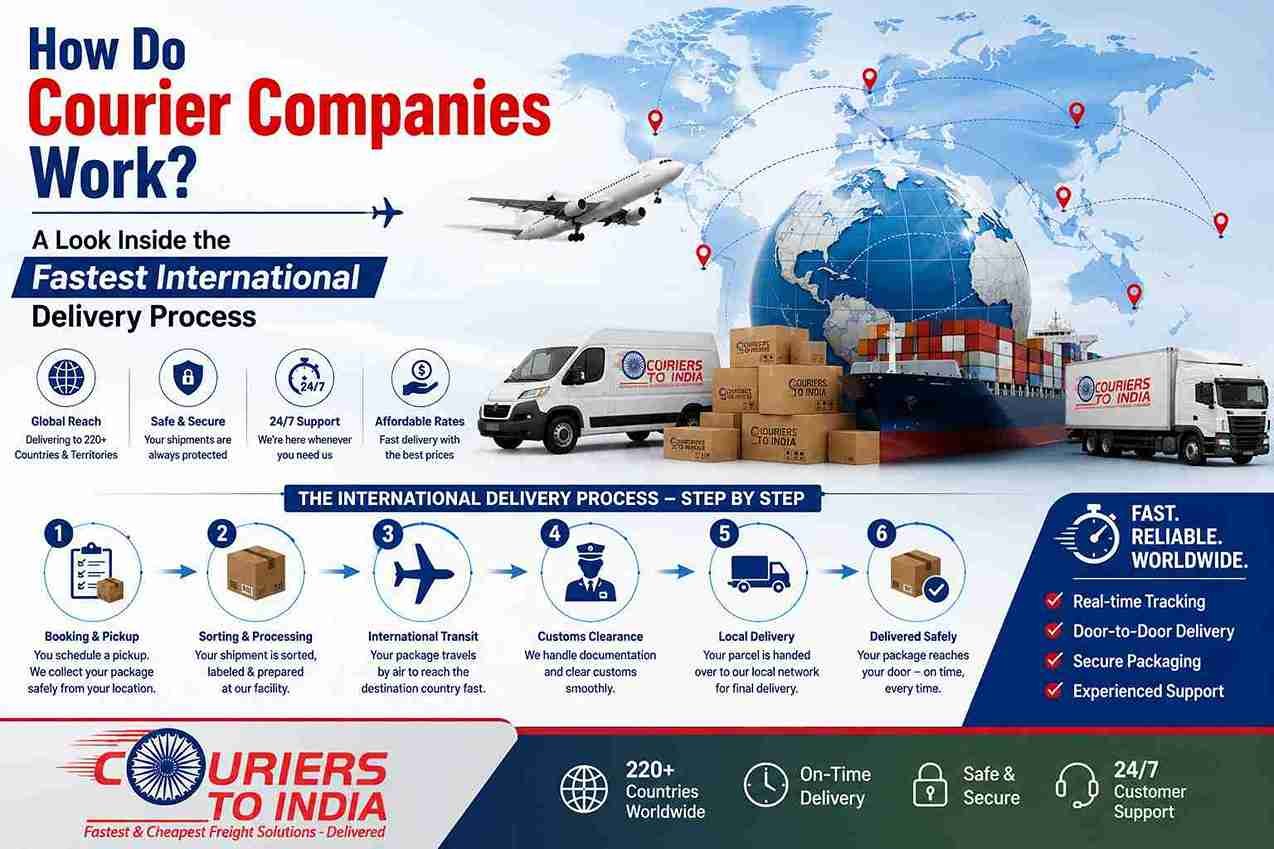
Although every courier company has its own operational processes and technology, most international shipments follow a structured workflow. Each stage is designed to move the package efficiently while maintaining shipment visibility and complying with transportation and customs requirements.
Let’s understand in detail
Every shipment starts with a booking.
Customers usually book a shipment through the website, customer support team, mobile application, or a local service representative. During this stage, the sender provides essential shipment information, including:
Once booking is confirmed, the courier company will allocate a guy to collect the package from your doorstep.
During collection, the courier representative typically:
This stage establishes the shipment’s identity within the courier company’s logistics network.
Once collected, the package enters the operational system and begins its journey toward the destination.
Proper packaging is essential for protecting shipments throughout international transportation.
During transit, packages may pass through multiple warehouses, sorting facilities, loading docks, cargo containers, aircraft, and delivery vehicles. Appropriate packaging helps reduce the risk of damage during routine handling.
Depending on the shipment, courier companies may verify the following:
Documentation is one of the most important parts of international shipping.
International shipping requires documents that help identify the shipment, describe its contents, and support customs processing.
Depending on the shipment type and destination, commonly required documents may include:
Once documentation is done, the shipment arrives at a sorting facility or logistics hub.
Sorting centers are responsible for identifying thousands of packages according to their destinations. Modern facilities often use barcode scanning and automated conveyor systems to improve efficiency and reduce manual handling.
During this stage, the shipment is:
Customs clearance is one of the most important stages of international shipping. Every shipment entering or leaving a country must comply with the customs regulations of both the origin and destination countries. Customs authorities review shipments to verify documentation, assess duties and taxes where applicable, and ensure that restricted or prohibited items are not being transported.
Export Customs Clearance
Before an international shipment leaves the country of origin, it may be subject to export customs procedures. During this stage, authorities or authorized logistics partners verify that the shipment meets export requirements.
Depending on the shipment and local regulations, the review may include:
Verification of shipping documents
Description and declared value of the shipment
Compliance with export regulations
Screening for restricted or controlled goods
Security checks before international transport
Import Customs Clearance
When one parcel reaches the destination country, the shipment undergoes import customs clearance. Customs officials examine the documentation submitted with the package and may inspect the shipment if required.
The import process generally includes:
Verification of shipment details
Review of customs declarations
Assessment of applicable duties or taxes, if any
Compliance checks with local import regulations
Clearance for local distribution
Why Accurate Documentation Matters
Incomplete documentation is one of the most common reasons for delays in international shipping.
For example, issues such as incorrect recipient information, incomplete shipment descriptions, missing invoices, or inaccurate declared values may require additional verification before customs clearance can be completed.
Providing complete and accurate shipment information at the time of booking helps reduce avoidable delays and supports a smoother customs process.
After completing export procedures, the shipment enters the international transportation network and travels from the origin country to the destination.
For most international shipments, air transport is used because it offers faster delivery for documents, parcels, and time-sensitive shipments. Depending on the route, road transport may also be used before and after the flight.
Shipments are grouped by destination, loaded into secure cargo containers, and moved through scheduled logistics networks. They may pass through one or more international logistics hubs before reaching the destination country.
Although only a few tracking updates may appear during this stage, the shipment continues to move through multiple operational checkpoints.
After international transportation, the shipment arrives in the destination country and enters the local logistics network.
Before delivery begins, it must complete customs clearance. Once cleared, the shipment is transferred to the courier company’s regional distribution network for local delivery.
During this stage, courier companies usually:
Tracking updates at this stage may include the following:
After customs clearance, the shipment is sent to a regional distribution center near the recipient’s address.
Here, packages are sorted by delivery route, postal code, and service area to prepare them for delivery.
During this stage, courier companies typically:
Efficient route planning helps reduce travel time and allows delivery personnel to complete multiple deliveries on a single route. Many courier companies also use route optimization software to improve delivery efficiency.
The final stage of the courier process is last-mile delivery, where the shipment is delivered from the local distribution center to the recipient’s address.
Although it covers the shortest distance, this stage requires careful coordination. Delivery teams navigate traffic, verify addresses, and ensure the shipment reaches the correct recipient.
During delivery, the courier representative may:
Customers usually see only the pickup, tracking updates, and final delivery, but many processes work behind the scenes to keep shipments moving smoothly.
Every shipment is supported by technology, transportation planning, warehouse operations, and logistics teams working together across multiple locations.
Let’s explore the key systems that help modern courier companies operate efficiently.
When a shipment enters the courier network, it is assigned a unique tracking number or barcode that acts as its digital identity throughout the journey.
The barcode is scanned at every major checkpoint, such as sorting facilities, airports, customs, and delivery centers. Each scan updates the tracking system and helps courier teams monitor the shipment’s progress.
Barcode scanning also reduces manual errors by ensuring packages are correctly identified and processed at every stage.
Shipment tracking has become an essential part of courier services.
Tracking systems collect information from barcode scans throughout the shipping journey and present status updates to customers through websites or mobile applications.
Depending on the courier company’s systems, customers may receive updates such as the following:
Sorting centers are a key part of a courier company’s logistics network, where thousands of parcels are processed every day.
Each shipment is scanned, sorted, and directed to the correct transportation route. Many modern facilities use automated conveyor systems and barcode scanners to speed up the process and sort packages by destination, delivery priority, and transportation schedules.
Despite automation, trained logistics professionals are essential for monitoring operations, handling exceptions, and ensuring shipments move accurately through the network.
Efficient transportation planning is essential for maintaining reliable delivery schedules.
Courier companies coordinate shipments across road networks, airports, and regional logistics hubs to ensure that packages reach their destinations as efficiently as possible.
Transportation planners consider factors such as the following:
Careful planning helps optimize available transportation resources while minimizing unnecessary delays.
International courier shipments require close coordination between logistics providers, customs authorities, and transportation partners.
Companies make shipping documents, submit required information, and monitor the customs process to support timely shipment movement.
Final delivery requires careful coordination between regional distribution centers and delivery personnel.
Before a package reaches the recipient, delivery routes are planned based on destination addresses, delivery priorities, and operational considerations.
There are a lot of factors when it comes to making fast delivery. This is achieved through careful planning, advanced technology, efficient transportation systems, and standard operating procedures. Today’s courier companies invest in logistics infrastructure that allows thousands of shipments to be in motion simultaneously, accurately, and with visibility.
Shorting out the parcel, as per its nature, is one of the most tedious and busy tasks. Every day, logistics warehouses receive thousands of parcels that people need to identify, scan, and route to their next destination.
Right now few big companies use automated sorting systems that can process high volumes of packages more efficiently than manual sorting alone. Automation helps:
Modern courier services rely on digital tracking systems that provide visibility throughout the shipping journey.
Tracking systems provide several benefits, including:
Courier companies use a combination of transportation methods depending on the shipment’s destination and service level.
These may include:
Courier operations require constant coordination between pickup teams, sorting facilities, transport partners, customs, and delivery teams.
Digital logistics systems help monitor shipment movement across the network, allowing operations teams to identify bottlenecks, adjust transportation schedules, and respond to unexpected disruptions when necessary.
This coordination helps to ensure operations run more smoothly, and delivery performance can be maintained at a reliable level.
Technology has transformed the courier industry by improving efficiency, reducing manual processes, and providing greater visibility throughout the shipping journey.
While technology does not eliminate every challenge in international logistics, it enables courier companies to manage large shipment volumes more effectively.
Below are some of the key technologies commonly used in modern courier operations.
Every shipment is assigned a unique identification code that is scanned at different stages of the delivery process.
Barcode technology helps:
This simple but effective technology forms the foundation of modern parcel tracking systems.
Large courier companies often use warehouse management systems to organize incoming and outgoing shipments within sorting facilities.
These systems help coordinate:
Planning efficient delivery routes is a crucial aspect of courier operations.
Route optimization software helps delivery teams organize deliveries based on factors such as:
Although courier companies strive to deliver shipments as efficiently as possible, several factors can influence overall transit time.
Understanding these factors helps customers set realistic expectations and prepare shipments more effectively.
The distance between the origin and destination is one of the most significant factors affecting delivery time.
Local delivery or short distance takes less then far destination
International shipments must comply with customs procedures before entering the destination country.
Most shipments are processed efficiently when documentation is complete. However, customs authorities may request additional information or inspect certain shipments as part of their regulatory responsibilities.
Incorrect or incomplete shipment information can affect multiple stages of the delivery process.
Examples include:
Heavy snowfall, storms, floods, and other weather conditions may disrupt road transport or air cargo operations.
National holidays in either the origin or destination country may affect shipment processing.
During holiday periods:
Planning shipments during peak holiday seasons can help reduce potential delays.
International courier services rely on scheduled air transportation.
Factors such as flight schedules, flight delays, cargo capacity, and operational changes may influence shipment movement, particularly during periods of high demand.
Larger shipments may follow different operational processes than standard parcels, depending on the courier company’s service offerings.
Proper packaging and accurate shipment information help ensure that larger shipments are processed efficiently.
While most shipments move through the courier network without big issues, delays can occasionally occur due to circumstances beyond the courier company’s direct control.
Some common reasons include:
Courier companies provide different shipping services to fulfill the needs of their customers. Your best option depends on factors such as how quickly you need it, the type of package you’re shipping, its destination, the size of your package, and your budget.
Knowing what types of services are available will allow customers to select the most appropriate shipping solution.
Express courier services are designed for urgent shipments that require faster transit than standard shipping options.
These services are commonly used for:
Economy courier services offer an affordable option for shipments that are not time-critical.
This option is often suitable for:
International courier services transport shipments between countries while coordinating customs documentation, transportation, and local delivery.
Depending on the destination, these services may include the following:
Parcel courier services are designed for everyday shipments sent by individuals and businesses.
These may include:
Many travelers, students, and families use excess baggage shipping services when carrying additional luggage during international travel is not practical.
Common items include:
Although courier companies manage transportation and logistics, customers also play an important role in helping shipments move smoothly through the delivery process.
Taking a few simple steps before dispatch can reduce the likelihood of avoidable delays.
Incorrect addresses or incomplete contact details can delay delivery.
Before confirming your shipment, verify:
Packages have to pass through several transportation and sorting facilities before reaching their destination.
Using sturdy packaging materials helps protect the contents during normal handling.
Depending on the shipment, consider using the following:
International shipping requires accurate documentation.
Review all shipping documents before dispatch and ensure that:
Proper documentation helps facilitate customs processing.
All countries have regulations for things that may be restricted or prohibited for import or export.
Before shipping internationally, check the applicable regulations to ensure your shipment meets local requirements.
If you are not sure about a particular item, please contact your courier provider before booking the shipment.
Different shipments have different priorities.
For example:
International shipping is not just about moving a package from one country to another. This needs to be integrated across documentation, customs procedures, transportation networks, and local delivery operations.
Instead of approaching all international routes equally, a dedicated one-way courier operator concentrates on one specific shipping corridor. This approach allows the company to become familiar with the requirements of shipments moving along that route.
This specialization can be an advantage for customers shipping to India.
For example, a courier service that primarily manages shipments originating in countries such as the United States, Canada, the United Kingdom, Australia, Singapore, and others overseas to India gains experience in:
At Couriers to India, our services are designed specifically for customers who need to send shipments from overseas to India.
As a specialized one-way international courier operator, we focus on simplifying the shipping experience by providing solutions tailored to India-bound deliveries.
Our services are designed to support individuals, families, students, and businesses sending a variety of eligible shipments to destinations across India.
Depending on the shipment requirements, customers can benefit from the following:
How do courier companies transport international packages?
International courier companies typically move shipments through a combination of road transportation, air cargo, customs clearance, regional distribution centers, and local delivery networks.
Why do packages pass through multiple sorting centers?
Sorting centers help organize shipments based on destination and transportation routes, allowing courier companies to move large volumes of packages efficiently.
How can I track my shipment?
Most courier companies provide a tracking number that allows customers to monitor important shipment milestones through an online tracking system.
What documents are usually required for international shipping?
Requirements vary depending on the shipment and destination, but commonly used documents include shipping labels, customs declarations, invoices, and supporting documentation where applicable.
Why can customs delay a shipment?
Customs authorities may require additional verification, inspect shipments, or request clarification if documentation is incomplete or if the shipment requires further review.
Does good packaging really matter?
Yes. Proper packaging helps protect shipments during transportation and reduces the likelihood of damage caused by routine handling.
What happens if nobody is available to receive the package?
The courier company’s delivery policy determines the next steps. Depending on the service, another delivery attempt may be scheduled or additional delivery instructions may be provided.
Can I ship fragile items internationally?
Many fragile items can be shipped if they are packed appropriately and comply with the courier company’s shipping guidelines and applicable regulations.
Are all items allowed in international courier shipments?
No. Every country maintains restrictions on certain goods. Customers should review applicable import and export regulations before shipping.
What factors influence international delivery time?
Delivery time may be affected by shipping distance, customs processing, transportation schedules, documentation accuracy, weather conditions, and destination-specific logistics.
Courier companies are not just about getting packages from point A to point B. Each international shipment is a coordinated process of collection, documentation, sorting, customs clearance, transportation, regional distribution, and last-mile delivery. Behind every successful delivery is a team of logistics experts, transportation partners, and technology systems working together to move shipments safely and efficiently.
Knowing how this process works helps customers prepare shipments correctly and choose the appropriate service, and it makes setting realistic delivery expectations easier.
If you’re looking for a trusted method to send shipments to India from countries like the United States, Canada, the United Kingdom, Australia, Singapore, and other international locations, Couriers to India is an expert in one-way international courier services for shipments to India. We want to make sending packages to India a trusted and hassle-free experience with dedicated support, shipment tracking, and guidance throughout the shipping process.
