
24×7 – 365 Days | orders@courierstoindia.com
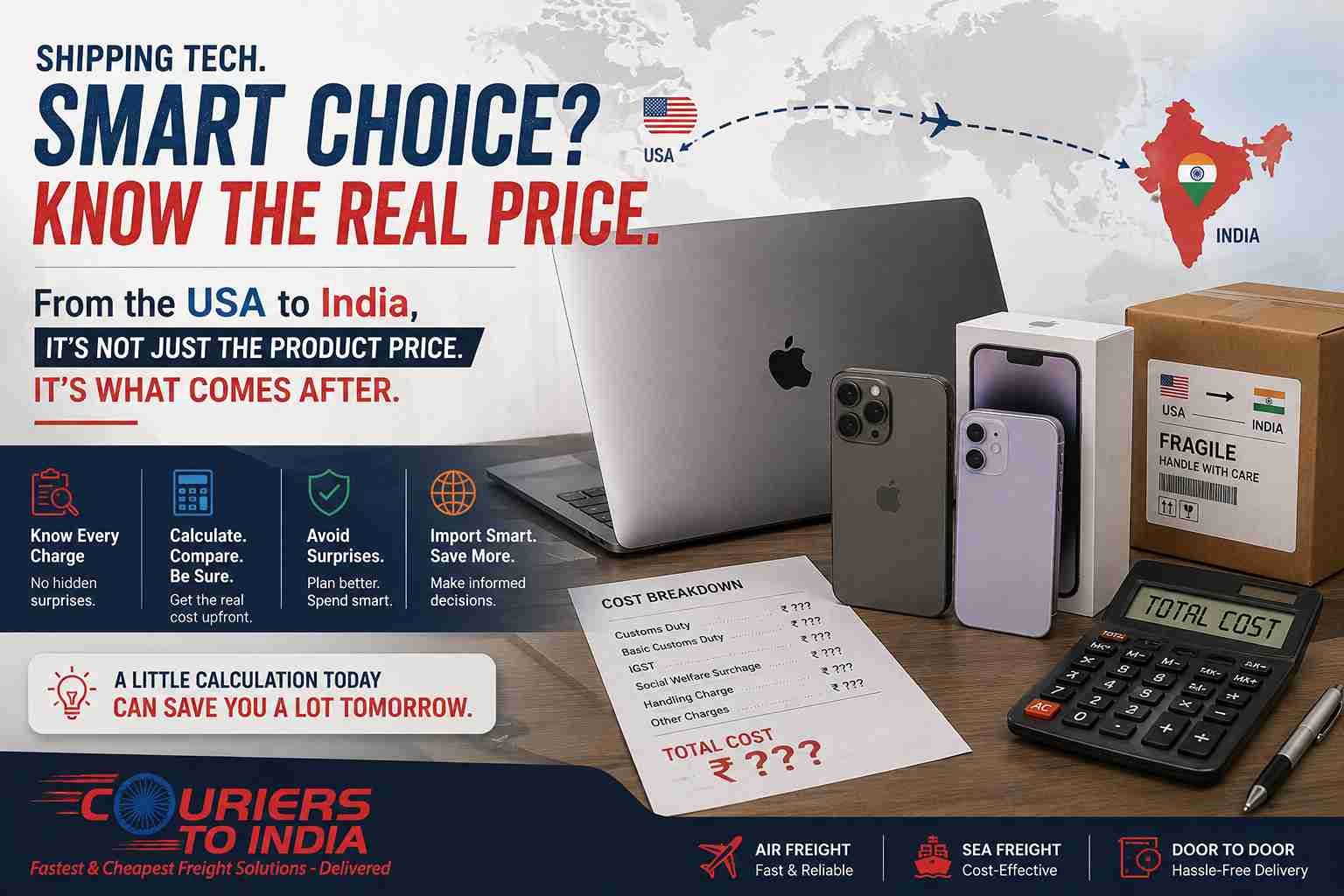
The Cost Reality
Shipping premium electronics through international courier services can result in substantial customs duties, taxes, and handling charges. Mobile phones attract Basic Customs Duty, Social Welfare Surcharge, and 18% IGST, creating a significant overall tax burden.
The Numbers
A high-end smartphone worth approximately ₹1,00,000 can easily incur over ₹40,000 in customs duties before courier fees are added.
Laptop Imports
Although laptops are exempt from Basic Customs Duty, they are still subject to 18% IGST on the total shipment value, which can add tens of thousands of rupees to the final cost.
Clearance Requirements
Recipients must complete KYC verification and ensure that shipping information matches government-issued identification to avoid delays and additional charges.
The Practical Choice
For most buyers, purchasing electronics directly in India or carrying them as personal baggage during travel is usually more convenient and cost-effective than shipping them through international couriers.
Most of the time, when purchasing a laptop (MacBook) or iPhone, it looks like we have saved a lot. People just look at the price and compare it with the Indian price, seeing that they are getting it cheaper from the Indian market.
However, the reality is far different. While carrying a personal device during international travel may fall under passenger baggage allowances, shipping a smartphone or laptop through commercial courier services such as Couriers to India, DHL, FedEx, or UPS subjects the package to India’s customs clearance and import regulations, taxes, and clearance procedures.
As a courier service provider, we have seen a lot of the same cases in which people have to pay a heavy clearance fee, so it’s the same as if you can purchase it in india. This guide explains how customs duties are calculated, the additional charges involved, and why shipping premium electronics like I phone or MacBook from the US to India is often far more expensive than expected.
One of the most common misunderstandings among senders is thinking that the same rules apply to courier shipments and personal baggage carried during travel.
Under India’s baggage regulations, travelers arriving in the country can benefit from duty-free allowances, including one personal laptop, phone, and a specified personal allowance. However, these rules do not apply when an item is shipped through an international courier service.
Once an iPhone, laptop, or any other electronic device enters India through a courier company, it is treated as an imported item. Customs authorities assess the full value of the item and impose duties and taxes on it.
Indian Customs does not simply calculate duties based on the invoice amount shown on your receipt. Instead of this, taxes are determined using the shipment’s CIF value.
Step 1: Calculating the Assessed Value (CIF)
The CIF value includes:
Cost of the device.
Insurance charges.
International shipping charges.
Assessed Value = Device Cost + Shipping Cost + Insurance Cost.
Even if the item was purchased at a discount or is a used device, customs officials may refer to prevailing market values if supporting documentation appears incomplete or inconsistent.
Step 2: Customs Duty Structure
After the CIF value is determined, customs duties are applied in multiple stages.
Basic Customs Duty (BCD)
Mobile Phones: 15% of the assessed value.
Laptops: 0% Basic Customs Duty.
Social Welfare Surcharge (SWS)
A surcharge of 10% is charged on the Basic Customs Duty amount.
Integrated GST (IGST)
An 18% IGST is levied on the combined value of:
Assessed Value (CIF).
Basic Customs Duty.
Social Welfare Surcharge.
Because IGST is calculated after adding previous duties, the overall tax burden increases significantly.
Let’s examine how customs duties impact a high-end smartphone shipment.
Shipment Details
Device Cost in the US: $1,199 (Approx. ₹1,00,000)
Shipping and Insurance: Approx. ₹8,300
Total Assessed Value (CIF): ₹1,08,300
| Tax Component | Calculation | Amount |
|---|---|---|
| Basic Customs Duty (15%) | 15% of ₹1,08,300 | ₹16,245 |
| Social Welfare Surcharge (10% of BCD) | 10% of ₹16,245 | ₹1,624.50 |
| Value for IGST Calculation | ₹1,08,300 + ₹16,245 + ₹1,624.50 | ₹1,26,169.50 |
| IGST (18%) | 18% of ₹1,26,169.50 | ₹22,710.51 |
Total Customs Duties
BCD: ₹16,245
SWS: ₹1,624.50
IGST: ₹22,710.51
Total Customs Charges: ₹40,580
| Expense | Amount |
|---|---|
| Device + Shipping | ₹1,08,300 |
| Customs Duties | ₹40,580 |
| Courier Clearance & Handling Fees | Approx. ₹3,500 |
| Final Delivered Cost | ₹1,52,380 |
| Example Insight: By this example, you can see that a smartphone purchased for approximately ₹1,00,000 reaches the recipient at a final landed cost of more than ₹1.5 lakh after customs duties and clearance charges are added. | |
Laptops are treated differently under Indian customs regulations because they currently have to pay a 0% Basic Customs Duty.
Since BCD is zero, the Social Welfare Surcharge also counts as zero. However, the laptop is still subject to 18% IGST based on the CIF value.
Example
Assume that you have purchased a MacBook Pro worth approximately ₹1,66,000 with shipping charges of ₹10,000.
Total CIF Value: ₹1,76,000.
IGST at 18%: ₹31,680.
Although laptops avoid Basic Customs Duty, the IGST liability alone can be substantial.
Additional Clearance Concerns
High-value laptops shipped through courier services may face additional observation from customs officials. Recipients may be required to provide declarations confirming personal use.
If authorities suspect commercial resale activity, additional documentation or compliance requirements may be requested, potentially delaying the shipment.
Import taxes are only part of the process. High-value electronic shipments mostly face operational hurdles that can delay delivery and increase costs.
KYC Verification Requirements
Before customs clearance can be completed, the recipient must submit valid KYC documents such as:
Aadhaar Card.
Passport.
PAN Card (where required).
Typical clearance process:
Sender Ships Device → Shipment Reaches India → Customs Hold for KYC → Recipient Uploads Documents → Clearance Approval
Even minor discrepancies between the recipient’s name on shipping documents and government-issued identification can result in delays or document rejections.
In such situations, shipments may remain in bonded warehouses until corrected documents are provided, potentially attracting storage or demurrage charges.
Lithium-Ion Battery Restrictions
Most of the smartphones, tablets, and laptops have lithium-ion batteries, which are subject to strict international air cargo regulations.
As a result:
Some postal services may not accept these shipments.
Premium courier providers are often required.
Additional compliance checks may be performed during transit.
These restrictions can increase shipping costs and limit available delivery options.
When customs duties, IGST, courier handling fees, shipping charges, and potential clearance delays are considered together, the apparent savings from purchasing electronics in the US often disappear.
Additionally, many devices purchased abroad may not include full warranty support in India, which can create difficulties if repairs or replacements are needed.
Purchasing through authorized Indian retailers ensures:
Genuine products.
Local warranty support.
Faster delivery.
No customs clearance issues.
Carry It During Travel
If your friend or family member is traveling to india so, sending a phone or a laptop as personal baggage is the simplest solution. Personal-use electronics carried during travel are generally treated differently from courier imports and can help avoid many of the costs associated with shipping.
